
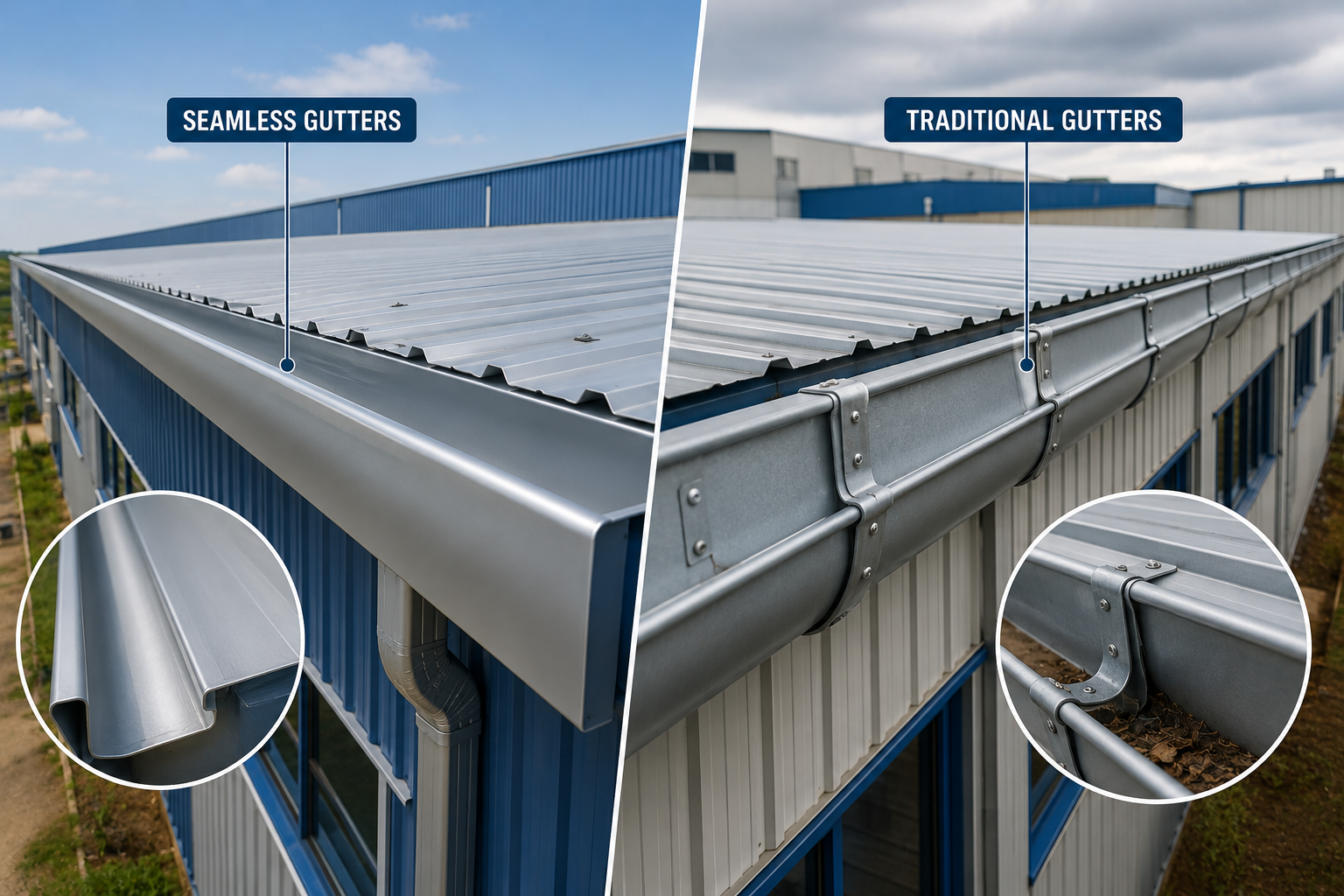
Gutters rarely get discussed in the early stages of a warehouse or factory project — everyone’s focused on span, roofing profile, and crane capacity. But when the monsoon arrives, the gutter system is what decides whether rainwater leaves the roof cleanly or finds its way into your foundation, flooring, or stored inventory.
Seamless gutters are formed as a single continuous run with joints only at corners and downspout outlets. For long industrial roof lines, this means dramatically fewer leak points, less debris buildup, and lower long-term maintenance making them the preferred choice for warehouses, manufacturing plants, and PEB buildings with large roof areas.
Traditional (sectional) gutters are built from shorter, pre-cut lengths joined with connectors and sealant. They’re simpler and generally faster to source and install, which makes them a reasonable choice for smaller structures or shorter roof runs, but every joint is a potential leak point that needs periodic inspection and resealing.
A seamless gutter is roll-formed from a continuous coil of metal into one unbroken length that runs the full stretch of a roofline, eave, or building bay — with joints appearing only at corners, ends, and downspout connections, not along the run itself.
For an industrial building, that difference matters more than it might sound. A 100-metre warehouse eave using traditional sectional gutters could easily involve dozens of joints. The same run in a seamless system might have none at all until it reaches a corner.
Where it’s typically specified:
Key features
Sovereign Infra Steels fabricates gutter systems in-house using dedicated eave gutter and valley gutter roll-forming equipment, producing continuous runs matched to the specific roof slope and rainfall load of each project rather than relying on generic stock lengths.
A traditional (or sectional) gutter system is built from pre-manufactured lengths — commonly a few metres each — that are joined on-site using connectors, overlaps, or sealant at each junction. Every joint is a mechanical connection that has to stay watertight for the life of the roof.
Because sections are standard stock items, they’re widely available, quick to source, and straightforward to install or replace individually if damaged.
Where it’s typically used:
Key features
| FEATURE | SEAMLESS GUTTERS | TRADITIONAL GUTTERS |
|---|---|---|
| Joints along the run | None (except corners/outlets) | Multiple, at every section |
| Leak risk | Low | Higher, concentrated at joints |
| Maintenance | Low | Moderate to high |
| Debris/clog risk | Lower — smooth internal surface | Higher — ledges form at joints |
| Appearance | Clean, continuous line | Visible joints along the run |
| Installation | Requires roll-forming/fabrication | Simple, modular assembly |
| Best for long roof runs | Excellent | Requires more joints, more risk |
| Individual section replacement | Not applicable (continuous run) | Straightforward |
| Life-cycle cost on large roofs | Generally lower | Generally higher due to joint maintenance |
| Typical use case | Warehouses, factories, PEB buildings | Small sheds, short runs, budget repairs |
This is the core difference between the two systems, and it scales directly with building size.
On a small structure, a traditional gutter run might only need two or three joints — manageable, low risk. But industrial buildings have long eave lines, often running the full length of a warehouse bay. Stretch that same jointed system across 80, 100, or 150 metres, and the number of joints — and therefore the number of potential leak points — climbs fast.
Seamless gutters sidestep this by forming the run as one continuous piece. The only joints that exist are at corners, ends, and downspout outlets — places that need a joint regardless of which system you choose. Everywhere else, water travels through an unbroken channel with nothing to leak from.
Traditional gutters rely on sealant and mechanical overlap at every section joint. Properly installed and maintained, these joints hold up reasonably well — but each one is a point that can loosen, degrade under UV and temperature cycling, or start weeping after a few monsoon seasons.
Industrial roofs shed large volumes of water fast during monsoon downpours, and the gutter system needs to move that volume without backing up onto the roof or overflowing at the fascia.
Seamless gutters offer a smooth, unbroken internal channel. Without ledges or overlaps interrupting the flow, water and debris move through more efficiently, and there are fewer spots where leaves, dust, or roofing debris can catch and accumulate.
Traditional gutters create small internal ledges at each joint where connectors overlap. Over time, these ledges can trap debris, which — if not cleared — contributes to localized clogging and standing water, particularly during heavy, sustained rainfall.
For high-volume industrial drainage, this is one of the more practical, day-to-day advantages of a seamless system.
Seamless gutters need comparatively little routine attention. With no joints to reseal along the main run, maintenance largely comes down to periodic debris clearing at corners and downspout inlets — a much smaller task than inspecting and resealing dozens of joints across a large roof.
Traditional gutters need a more active maintenance schedule:
For a warehouse roof that’s difficult and costly to access, this recurring maintenance adds up in both labour and downtime — every inspection typically needs scaffolding, a lift, or roof access equipment.
Seamless gutters, fabricated from Galvalume or galvanized steel with a quality coating, tend to hold up well over long periods because there are fewer weak points along the run to fail first. The absence of joints along straight sections means the system’s overall integrity doesn’t depend on dozens of individual seals staying intact.
Traditional gutters are durable within their intended scope, but their long-term performance is closely tied to how well each joint is maintained. Left unmaintained, joint failure is typically the first sign of aging in a sectional system — well before the gutter material itself gives out.
As with most industrial building decisions, the honest comparison isn’t installation cost alone — it’s installation plus maintenance over the building’s working life.
Seamless gutters may involve a higher setup cost, particularly where custom roll-forming is required for the specific roof geometry. That investment is generally offset over time through:
Traditional gutters typically cost less to source and install initially, using standard stock lengths and simple connectors. This makes them a reasonable choice for smaller buildings or shorter runs where the total joint count — and therefore long-term risk — stays low. On larger industrial roofs, though, the cumulative maintenance cost of dozens of joints can erode that initial saving over a 10–15 year period.
A practical way to decide: the longer the continuous eave run, the stronger the case for seamless gutters — both on leak-risk grounds and on total cost over the building’s life.
Gutter type and gutter location are two separate decisions, and both matter in a PEB roofing system.
Eave gutters run along the roof edge and collect water shed from sloped roof panels — the most common gutter application on a warehouse or factory building.
Valley gutters sit between two adjacent roof slopes or adjoining buildings, managing the point where water flow converges from multiple directions. Valley gutters typically need a larger capacity than eave gutters because they handle concentrated flow rather than a single roof slope’s runoff.
Downtake pipes, positioned at the low points of the gutter run, carry collected water down to ground level or a stormwater system. These are typically hollow, cold-formed sections in PVC, stainless steel, or aluminium, fluted for added stiffness and secured with clamps to resist wind and movement.
Whether you choose seamless or traditional gutters, getting the eave gutter, valley gutter, and downtake sizing right — matched to your roof’s slope, area, and local rainfall intensity — matters just as much as the joint style.
Seamless gutters fit well for:
Traditional gutters fit well for:
Lean toward seamless gutters if you want:
Lean toward traditional gutters if you want:
For most warehouses, factories, and PEB buildings with long, continuous roof lines — which describes the majority of industrial projects in India — seamless gutters are generally the stronger long-term choice, particularly given how much water an industrial roof needs to shed during peak monsoon rainfall.
A gutter system is only as reliable as the manufacturing behind it. Sovereign Infra Steels Pvt. Ltd. (SISPL) fabricates roofing and drainage components in-house at its Chakan, Pune facility, including:
Because roofing, gutters, and structural steel all come from a single in-house facility, SISPL can match gutter type, size, and downtake placement to the actual roof geometry and rainfall load of each project — rather than fitting a generic drainage profile to every building.
Gutters don’t get the attention that structural spans and roofing profiles do, but on an industrial building, they’re doing serious work every monsoon season. For long roof runs on warehouses, factories, and PEB structures, seamless gutters generally offer the better long-term outcome — fewer leak points, lower maintenance, and better performance under heavy rainfall. Traditional gutters still have a place for smaller structures or shorter runs where upfront cost is the deciding factor.
Our Projects
Hyundai Glovis India
JSW Steel Ltd.
John Deere
SANY Heavy Industries
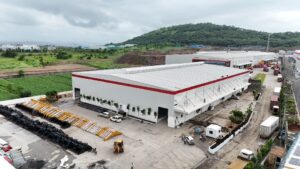
Hyundai Mobis
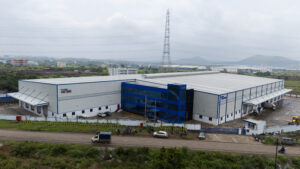
Asahi India Glass Ltd.
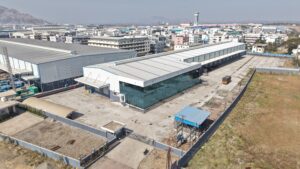
General FAQs
Seamless gutters are formed as one continuous run with joints only at corners and outlets, while traditional (sectional) gutters are built from shorter pre-cut lengths joined together with connectors and sealant along the run.
Generally, yes. Industrial roofs have long eave runs, and seamless gutters minimize the number of joints across that length, reducing leak risk and long-term maintenance compared to a sectional system.
Yes, typically. Because seamless gutters have far fewer joints along a given run, there are fewer places for seals to degrade and leaks to develop over time.
Seamless gutters can involve a higher initial cost, particularly for custom roll-forming, but this is often offset over the building's life by lower maintenance and fewer leak-related repairs — especially on long industrial roof runs.
Need Help?
Download Our Company Profile
Please fill in the form below to receive the brochure.
This will close in 0 seconds
Email us with any questions or inquiries.