
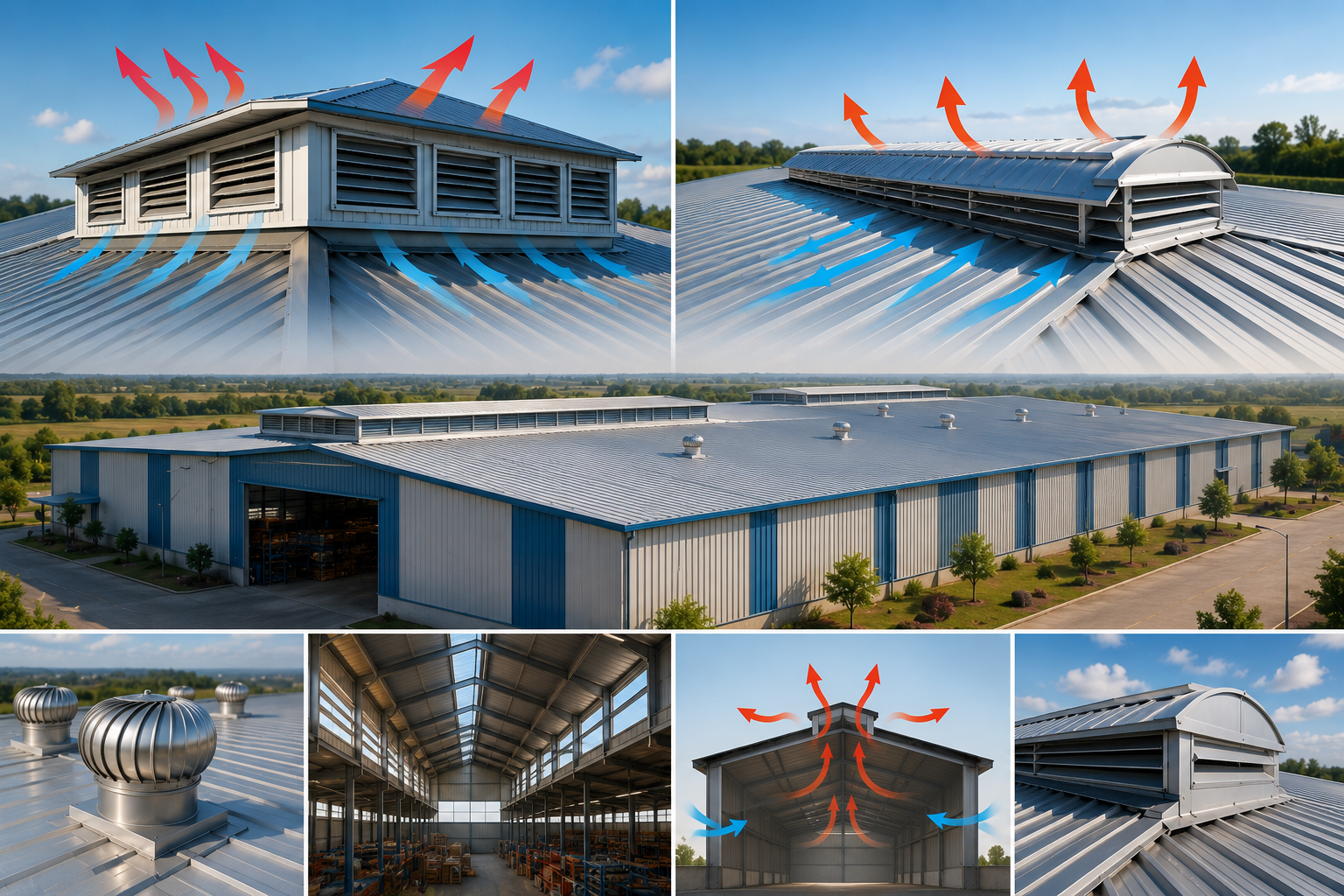
Every industrial roof does two jobs at once: it keeps the weather out, and it decides how heat, humidity, and fumes leave the building. On a pre-engineered building (PEB), that second job usually comes down to a choice between two roof-level systems — the ridge monitor and the ridge ventilator.
Suppliers sometimes use these terms loosely, which is where confusion starts. A ridge monitor is a raised, boxed-out section of the roof with its own walls and roofline. A ridge ventilator is a slim exhaust device or continuous opening fitted along the ridge line. They solve a similar problem — hot air trapped near the roof — but they do it in structurally different ways, and that difference drives cost, daylighting, and long-term maintenance.
This guide breaks down how each system works, where each one earns its cost, and what to check before specifying one for a warehouse, factory, or logistics shed.
Think of it this way: a ridge ventilator is an opening. A ridge monitor is a room.
A ridge ventilator sits directly on the roof slope at the highest point and lets warm air escape through a protected gap, hood, or louvered unit. A ridge monitor raises part of the roof itself — it has vertical side walls, its own small roof, and often windows or louvers built into those walls. That raised structure is what lets a monitor pull double duty as a ventilation outlet and a source of natural daylight.
Both rely on the same physics: warm air rises and needs somewhere to go, and that only works if cooler replacement air can get in near ground level. A ridge system without adequate low-level air inlets — wall louvers, eave openings, or doors — will underperform no matter how well it’s built. This is the detail most first-time buyers miss, and it matters more than the brand or throat size printed on a datasheet.
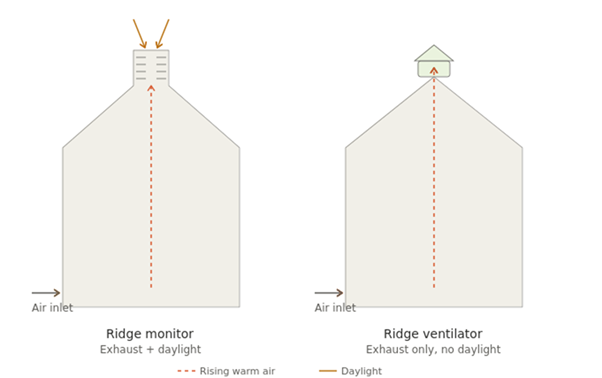
A ridge monitor raises the central section of the roof above the surrounding roof plane. Its vertical sides can carry louvers, fixed windows, or translucent panels. Warm air collects near the roof peak and exits through the monitor’s openings, while the raised walls double as a source of natural light for the floor below.
Example: a fabrication shop running welding stations, ovens, or compressors generates heat that pools well above head height. A monitor sized correctly for that heat load can pull the hot layer out before it settles back into the working zone — something a flat ridge line struggles to do on its own.
A monitor is a structural addition, not a bolt-on accessory. It introduces extra roof junctions, flashing lines, and wind-exposed surfaces that need to be engineered alongside the PEB frame — not added as an afterthought once the building is designed. Get the transitions wrong and you trade a ventilation upgrade for a leak risk.
A ridge ventilator is fitted at the roof’s highest point and provides a protected path for warm air to leave the building. Baffles, weather hoods, or overlapping profiles keep rain and wind-driven debris out while air keeps moving. Units can be installed individually in select bays, or run continuously along the length of the roof.
A ridge ventilator for PEB buildings earns its place when a project needs passive heat relief without the added steelwork, glazing, and waterproofing detail a monitor requires. It’s the more common choice for warehouses, distribution centres, and general manufacturing sheds where daylighting isn’t the priority.
The same rule applies here as with a monitor: a ridge ventilator without enough low-level inlet area won’t move the volume of air the datasheet promises. Wall louvers or eave vents are part of the system, not an optional extra.
If you’re comparing ridge ventilator manufacturers in India, look past the quoted unit price. Airflow performance data, sheet gauge and coating quality, fixing and flashing details, and after-sales support for a product that will sit on a roof for a decade matter far more than a lower number on the first quote.
| Factor | Ridge Monitor | Ridge Ventilator | Why it matters |
|---|---|---|---|
| Structure | Raised roof section with vertical walls | Low-profile unit or opening on the roof slope | A monitor adds framing and waterproofing detail; a ventilator does not |
| Daylighting | Yes, via clerestory windows or translucent panels | Minimal to none | Deciding factor for deep floor plates far from side walls |
| Initial cost | Higher — extra steel, glazing, flashing | Lower — simpler installation | Compare installed cost, not just unit price |
| Structural coordination | Significant — must be engineered with the PEB frame | Moderate — still needs roof and wind-load review | Poor coordination on either system risks leaks |
| Maintenance | More inspection points (flashing, glazing, joints) | Fewer moving parts and junctions | Coastal or high-dust sites should weigh this heavily |
A monitor brings daylight deep into a large floor plate, where side-wall windows alone can’t reach. It also adds usable vertical volume beneath the raised section — useful for overhead cranes, mezzanine storage, or tall process equipment. The trade-off is engineering effort: primary frame, secondary steel, bracing, flashing, and drainage all need to work together, and the raised form increases exposure to wind uplift in storm-prone regions.
A ridge ventilator is the more direct route to removing hot air, and it can be arranged bay-by-bay to match where heat actually collects. It’s the practical choice when the owner wants passive ventilation without the daylighting and structural complexity of a monitor. Its limitation: less daylight, less added volume, and performance that depends entirely on correct airflow balancing across the building.
Ventilation suppliers often quote a system by “air changes per hour,” or ACH. In plain terms, this is how many times the entire volume of air inside the building is replaced in one hour. A shed with 6 ACH has its full internal air volume swapped out six times every hour.
The number on its own tells you little. What matters is whether the required ACH for your building — driven by heat load, occupancy, and any process fumes — matches what the ridge system, plus its inlet air path, can actually deliver. A ridge ventilator rated for a given airflow figure will not hit that number if the building’s wall louvers are undersized or blocked by storage racks. Ask any supplier for the ACH figure alongside the assumed inlet free area — one without the other is not a usable specification.
A complete PEB roof ventilation system rarely relies on one device alone. It typically combines a ridge-level outlet with low-level inlets and, where needed, mechanical support. Common types of roof ventilators for industrial buildings include:
Wall louvers and eave inlets aren’t ventilators themselves, but no roof-level system performs without them — they’re the intake half of the airflow path.
Map where heat is generated and how it moves through the building. A uniform warehouse load behaves very differently from a plant running furnaces, paint booths, or boilers. Localized fumes or dust often need extraction close to the source, not dilution at roof level.
Don’t compare products on throat size or appearance alone. Establish the required ACH, internal heat load, and opening area first, then check supplier performance data against your building’s actual geometry.
Every exhaust system needs replacement air to work. Confirm that wall louvers, doors, or eave openings provide enough free area, and that internal partitions, racks, or mezzanines don’t block the path from inlet to ridge outlet.
Review baffles, weather hoods, flashing, bird mesh, corrosion protection, and inspection access. In coastal or high-dust locations, ongoing maintenance often matters more than the upfront equipment price.
The PEB engineer needs to verify added dead load, wind forces, and connection details. A monitor typically demands more coordination than a ventilator, but any roof penetration deserves the same scrutiny.
Wind direction, monsoon exposure, dust, and temperature swings all affect real-world performance. A system that works well in a dry, windy region may need different weather protection — or mechanical backup — in a humid or low-wind site.
A straight price comparison misleads more often than it helps. A ridge monitor usually costs more upfront because of the extra structural steel, roofing, cladding, and glazing or louvers involved — but it can deliver daylight and usable height a ventilator cannot.
A ridge ventilator carries a lower installation cost, but the full system still includes roof modifications, flashing, inlet louvers, and maintenance access. If passive airflow later proves insufficient and the building needs powered exhaust added, that initial saving can disappear fast.
The comparison that actually holds up looks at four things together: capital cost, energy impact, maintenance cost, and operational value. A factory running hot processes all day may get real value from a monitor’s daylighting and high-level heat relief. A storage warehouse with moderate heat gain will often do just as well with a continuous ridge ventilator paired with wall louvers — at a fraction of the cost.
The most frequent mistake is treating the ridge device as a standalone product rather than one half of a system. Close behind it: specifying a unit without first calculating heat load or required air changes, and assuming a bigger opening automatically means better performance.
Any one of these can turn a ventilation upgrade into a source of leaks, corrosion, or poor airflow — problems that cost more to fix than they would have to prevent.
Sovereign Infra Steels designs, fabricates, and erects PEB roofing and ventilation systems in-house at our Chakan, Pune facility — from initial PEB design through structural fabrication to on-site erection. If you’re planning a new industrial shed or upgrading ventilation on an existing one, our engineering team can assess your heat load and recommend the right ridge system before you commit to a design.
Explore our turnkey construction services, browse recent projects, or get in touch for a ventilation assessment.
The Ridge Monitor vs Ridge Ventilator decision should come down to what the building needs to do, not which term sounds more advanced. A ridge monitor delivers a raised roof form that combines natural ventilation, daylighting, and extra vertical volume, at the cost of more structural and waterproofing coordination. A ridge ventilator delivers a simpler, more focused way to exhaust rising hot air, and it works well for the majority of PEB and industrial sheds.
Start any decision with the building’s actual heat sources, required air changes, inlet strategy, roof geometry, and climate — then compare the complete installed system, not just the device sitting at the ridge. Specified correctly, either solution supports natural ventilation for industrial sheds, improves working conditions, and cuts reliance on mechanical cooling for basic heat relief.
Our Projects
Hyundai Glovis India
JSW Steel Ltd.
John Deere
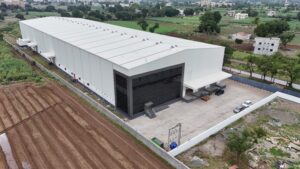
SANY Heavy Industries
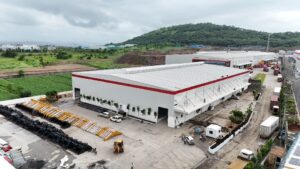
Hyundai Mobis
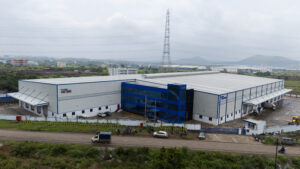
Asahi India Glass Ltd.
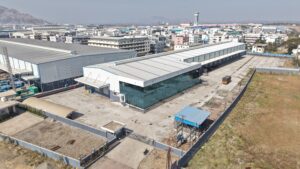
General FAQs
No. A ridge monitor is a raised roof structure that combines ventilation with daylighting. A ridge ventilator is a dedicated exhaust device or opening at the roof ridge. Because suppliers use the terms loosely, always confirm the system in the drawings and technical specification.
No. Suitability depends on heat generation, building height, required airflow, inlet openings, and the nature of any fumes or contaminants. A passive ridge system should never replace required source-capture or mechanical exhaust for hazardous emissions.
The combination of high-level natural ventilation and daylighting. Monitors are most valuable in large, deep buildings where side-wall windows can't reach far enough, or where hot air consistently collects above the working level.
Yes. They can be fitted as individual units in selected bays or as a continuous run, depending on required airflow and roof design. The final layout should be coordinated with the PEB manufacturer and roofing designer.
A ridge monitor if the factory also needs daylight and extra high-level volume. A ridge ventilator if straightforward heat exhaust is the only goal. If the process generates hazardous fumes, design around source extraction and applicable safety codes — not passive ventilation alone.
Need Help?
Download Our Company Profile
Please fill in the form below to receive the brochure.
This will close in 0 seconds
Email us with any questions or inquiries.