
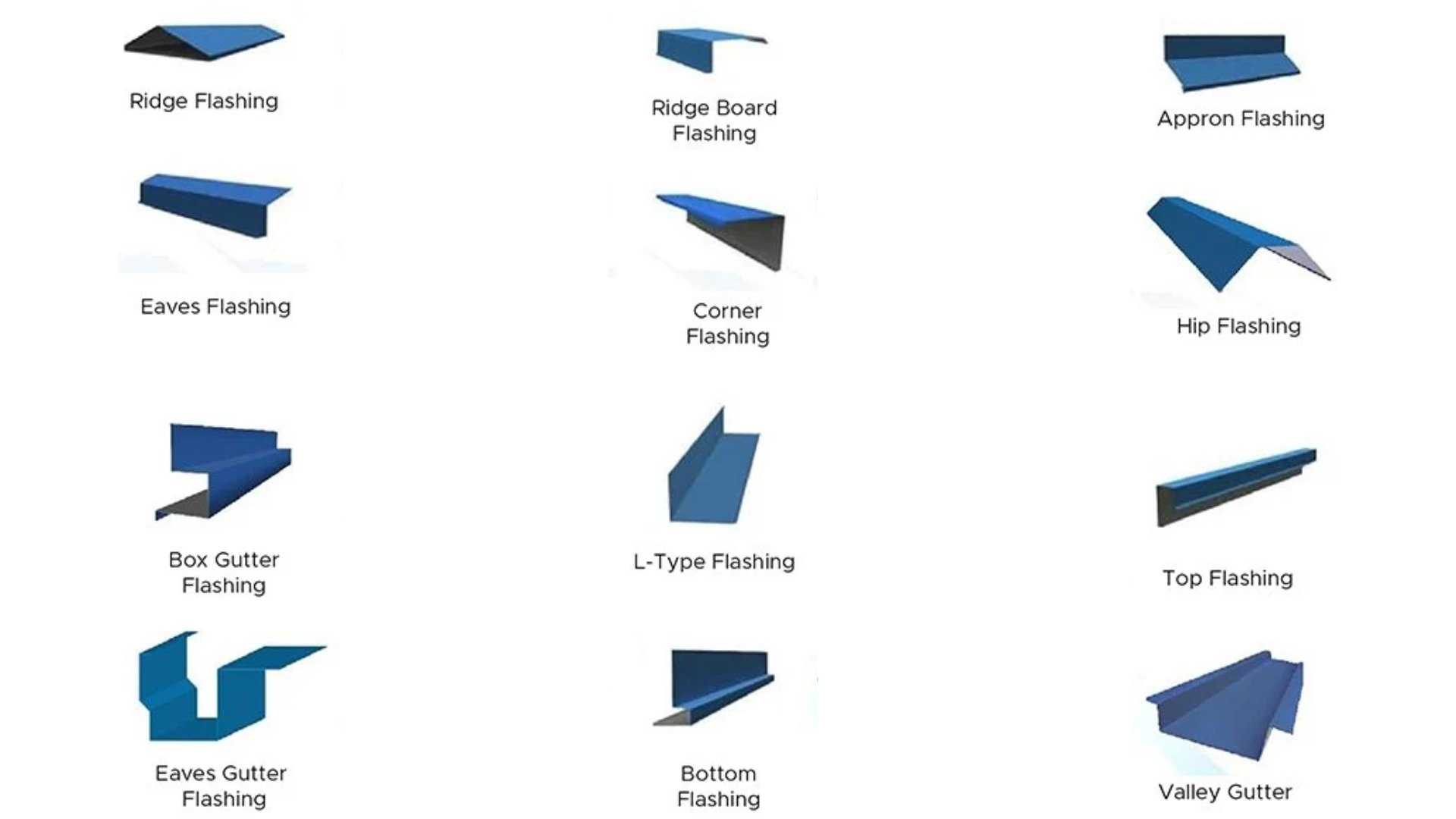
Water is the single biggest enemy of any steel structure. In Pre-Engineered Buildings (PEB), the roof and wall panels can be engineered to perfection, but if the joints, edges, and transitions aren’t sealed correctly, water finds a way in. That’s the job flashing does.
Flashing is a thin, formed metal component installed at every point where two building surfaces meet — roof to wall, ridge to slope, corner to corner. It directs rainwater, dust, and debris away from these joints instead of letting them seep through. Without it, even a well-designed PEB structure will develop leaks, rust patches, and insulation damage within a few monsoons.
For B2B buyers evaluating PEB contractors or fabricators, understanding flashing types isn’t a technical afterthought — it directly affects the building’s lifespan, maintenance cost, and warranty terms. This guide breaks down every flashing type used in PEB construction, the materials involved, and how to choose the right combination for your project.
In a PEB structure, flashing refers to the sheet metal accessories installed at junctions, penetrations, and edges of the roofing and cladding system. These are not decorative trims — they are functional waterproofing components engineered to match the panel profile, slope, and material specified by a pre-engineered building manufacturer.
A typical industrial shed or warehouse has dozens of such junctions: where the roof meets a wall, where two roof slopes converge, where the building ends, and where the base meets the foundation. Each junction behaves differently under wind load and rainfall, which is why PEB manufacturers use a specific flashing type for each location rather than a single generic strip.
Why this matters for buyers: if your PEB vendor quotes a project without listing individual flashing types by location, ask for clarification. Generic or under-specified flashing is one of the most common causes of post-handover leak complaints in industrial buildings.
Each flashing type below serves a distinct location on the building envelope. Using the wrong one — or skipping one — creates a weak point that will eventually fail.
Installed along the lower edge of the roof where it overhangs the sidewall, eave flashing controls water runoff and prevents it from tracking back under the roof sheet due to wind pressure (a phenomenon called wind-driven rain). In coastal or high-rainfall regions, this is one of the first components to check during a site audit, since eave joints see the highest water volume of any part of the roof.
Ridge flashing sits at the highest point of the roof, where two opposite roof slopes meet. It’s designed to allow ventilation (in vented ridge systems) while blocking rain and dust ingress. A poorly fitted ridge flashing is a common cause of ceiling stains in warehouses, since the ridge line runs the full length of the building and any gap compounds over that distance.
Also called rake flashing, this covers the sloped edge of the roof at the gable (triangular) end wall. It protects the exposed edge of the roof sheeting and the top of the gable trim from wind-lifted rain. On buildings in open, wind-exposed sites, gable flashing also adds mechanical fastening strength to resist uplift.
Used at the vertical corners of the building where two wall panels meet at 90 degrees. Corner flashing manages both water shedding and thermal expansion — steel panels expand and contract with temperature, and the flashing accommodates this movement without cracking the seal.
Installed where the wall panel meets the plinth or foundation. This is the flashing most exposed to standing water, splash-back, and soil moisture. Base flashing is typically paired with a sealant or damp-proof course to stop capillary moisture from rising into the wall system — a detail that matters most in industrial sheds built near drainage channels or low-lying plots.
Found where two roof slopes meet at an internal angle (the opposite of a ridge), valley flashing handles concentrated water flow, since rainwater from two slopes converges into one channel. This is arguably the highest-stress flashing location on a multi-span PEB roof and needs a wider, thicker gauge than standard flashing.
This covers any junction where a roof plane meets a vertical wall that isn’t at the eave — for example, where a lower roof meets a taller adjoining structure. It’s common in PEB expansions or buildings with mezzanine-level roof steps, and it needs custom fabrication since the geometry differs on every project.
Installed at the end walls of the building (the non-load-bearing gable ends), endwall flashing seals the transition between the roof framing and the endwall cladding. It works alongside gable flashing but specifically addresses the horizontal roof-to-endwall seam rather than the sloped edge.
| Flashing Type | Location on Building | Primary Function |
|---|---|---|
| Eave | Roof edge over sidewall | Controls water runoff, resists wind-driven rain |
| Ridge | Roof peak | Seals/ventilates the highest joint |
| Gable | Sloped roof edge at gable end | Protects roof edge, adds uplift resistance |
| Corner | Vertical wall corners | Manages water shedding and thermal movement |
| Base | Wall-to-foundation joint | Blocks splash-back and rising moisture |
| Valley | Internal roof slope junction | Channels concentrated water flow |
| Roof-to-wall | Roof meeting a taller wall | Seals stepped or multi-level roof junctions |
| Endwall | Roof-to-endwall seam | Seals horizontal transition at building ends |
Flashing material should always match — or be compatible with — the roofing and cladding sheet material to avoid galvanic corrosion (a reaction that occurs when dissimilar metals stay in contact with moisture).
Practical example: a PEB warehouse near a coastal port in Gujarat will typically need aluminum or higher-grade Galvalume flashing with a thicker coating mass, while an inland dry-climate shed in Rajasthan can perform well with standard GI flashing at a lower cost. Material selection should follow the site’s environmental exposure, not just the lowest quote.
Flashing material quality only matters if the installation is precise. In practice, most PEB leak complaints trace back to installation error, not material failure.
For B2B buyers, this is why the installation crew’s experience matters as much as the flashing specification sheet. A correctly specified flashing installed poorly will still leak.
Most of these issues surface within the first two monsoon seasons, which is why a pre-monsoon flashing inspection is a standard recommendation for any operational PEB facility.
Flashing problems can affect the weather protection and service life of an industrial building. An experienced industrial shed manufacturer should account for these vulnerable areas during design, fabrication, and installation.
Our Projects
Hyundai Glovis India

JSW Steel Ltd.

John Deere
SANY Heavy Industries

Hyundai Mobis

Asahi India Glass Ltd.
General FAQs
Flashing seals the joints between roof and wall panels to stop water, dust, and pests from entering the structure at points the main sheeting can't cover.
Valley and ridge flashing typically see the highest failure rates, since they handle concentrated water flow or sit at the most exposed point of the roof.
It can, but it should be metallurgically compatible to avoid galvanic corrosion. Matching material families (e.g., Galvalume flashing with Galvalume roofing) is the safer default.
At least once a year, ideally before the monsoon season, and after any major storm event that could have loosened fasteners or lifted panel edges.
Yes. Most PEB manufacturers tie roof warranties to correct flashing installation, since improperly sealed joints are a leading cause of premature panel or insulation damage.
Not necessarily. Thickness should match the location's stress and exposure level — over-specifying every location adds cost without proportional benefit, while under-specifying high-stress zones like valleys creates risk.
Need Help?
Download Our Company Profile
Please fill in the form below to receive the brochure.
This will close in 0 seconds
Email us with any questions or inquiries.