
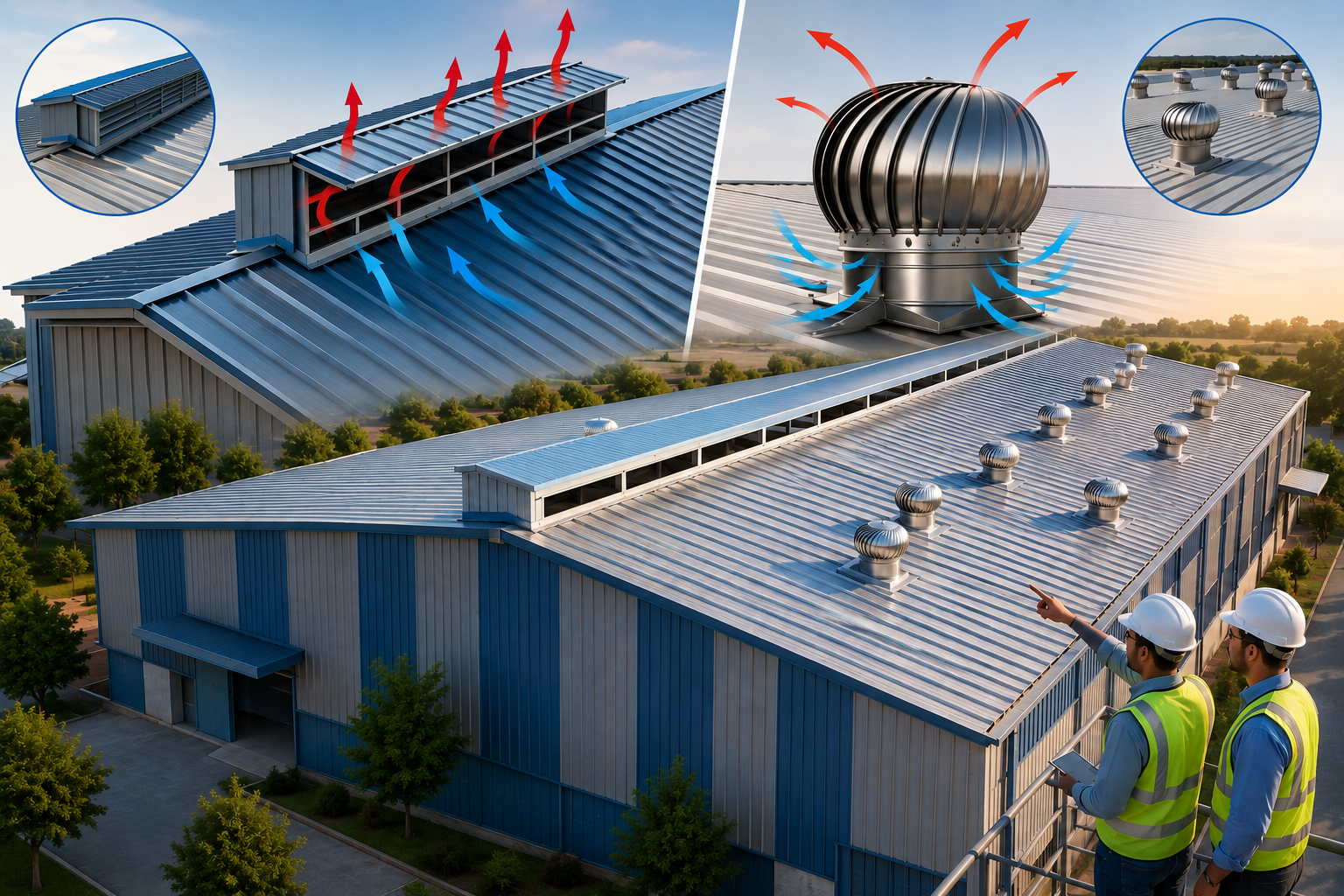
Ventilation is rarely the first thing people think about when planning a Pre-Engineered Building, but it’s often the thing that decides whether the finished building is actually comfortable to use all year round. Industrial sheds, warehouses, and manufacturing facilities create heat from machines, people working inside, and the sun beating down on the roof — and without a proper plan for letting that hot air out, it just keeps building up near the roof, raising the temperature inside and making the air quality worse.
Two solutions come up again and again when planning ventilation for a PEB: the Ridge Monitor and the Turbo Ventilator. Both work using natural airflow instead of powered fans, but they get the air moving in completely different ways — and that difference in how they work is exactly what should guide which one you pick, not just personal preference or habit. This guide compares Ridge Monitor vs Turbo Ventilator in practical terms and explains which one fits better for different types of PEB buildings.
A ridge monitor is a raised structural arrangement provided along the ridge of a PEB roof. It creates a continuous elevated section at the highest point of the building, allowing natural ventilation and daylight to enter the building while facilitating the escape of hot air.
Ridge-level ventilation systems are commonly positioned at the highest point of industrial roofs to facilitate the natural exhaust of hot air and humidity through the stack effect. Roof ventilation ridge vent
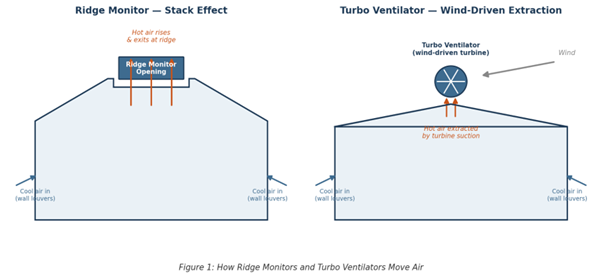
The system works on the principle of the stack effect. As the internal temperature increases, warm air rises and accumulates near the highest point of the building. The openings provided in the ridge monitor allow this hot air to escape naturally, while cooler air enters through lower-level openings such as louvers, doors, or wall inlets.
Unlike a conventional point ventilation system, a ridge monitor can extend along a significant portion of the building length, making it particularly suitable for large industrial buildings, manufacturing facilities, and warehouses.
A turbo ventilator is a device mounted on the roof that uses wind — not electricity — to pull hot, stale air out of a building. A Wind Driven Turbo Ventilator has rotating blades or vanes fitted on a roof-level unit; as wind blows across it, the turbine spins and creates suction that pulls warm air out through the opening underneath it.
Because this basic setup doesn’t need electrical power to run, a turbo ventilator is a genuinely simple option for natural ventilation — which is exactly why it’s so commonly added to existing sheds where running new electrical wiring for powered exhaust fans isn’t practical.
A Turbo Ventilator for Industrial Sheds works through a simple sequence once wind is present:
The practical catch is right there in step 1: without wind, the turbine doesn’t spin, and it stops pulling air out effectively. The performance of turbine ventilators can vary with wind speed, ventilator size, blade configuration, and construction, as demonstrated in experimental testing of commercial turbine ventilators. Performance testing and comparison of turbine ventilators
A Roof Monitor Ventilation System uses a raised roof structure to create a continuous or spread-out opening near the highest part of the building — this is really the broader engineering category that a ridge monitor belongs to. Unlike individual turbo ventilators, which each only pull air from a small, local area, a roof monitor can ventilate a large stretch of the roof as one connected system, which is what makes it especially useful for large PEBs where heat builds up unevenly across a wide floor.
The main difference comes down to what actually moves the air — temperature-based rising air versus wind-powered spinning, as explained below.
| Feature | Ridge Monitor | Turbo Ventilator |
|---|---|---|
| Ventilation principle | Natural buoyancy (stack effect) and pressure differences | Wind-driven turbine extraction |
| Installation | Continuous along the roof ridge | Individual roof-mounted units at selected points |
| Coverage | Continuous ridge-level ventilation across building length | Distributed, point-based extraction |
| Moving parts | Generally none — a static opening | Rotating turbine with bearings |
| Wind dependence | Low — driven mainly by temperature difference, not wind | High — performance drops significantly in low-wind conditions |
| Best suited for | Large PEBs designed from the outset with continuous ventilation needs | Existing industrial sheds needing point-based retrofit ventilation |
| Maintenance | Relatively low — mainly flashing, screens, and corrosion checks | Higher — bearings and rotating components need periodic inspection |
A Ridge Ventilator for PEB Buildings offers several advantages when a building needs a lot of reliable natural ventilation.
A turbo ventilator remains a genuinely useful solution for many industrial situations, especially where you’re adding ventilation to an existing building.
Natural Ventilation for Steel Buildings should be planned around the building’s size, shape, how much heat is generated inside, how many people occupy it, the local climate, and how the building is actually used — not chosen as a standard, one-size-fits-all package regardless of these factors.
A ventilation system doesn’t work well just because an exhaust device has been installed. Extraction only works properly if there’s also a suitable path for fresh air to come in and replace what’s being pulled out — an exhaust-only system without enough inlet space will underperform no matter how well the exhaust part itself is designed. Typical paths for air to come in include:
It’s the combination of air coming in and air going out at a high level — not just one or the other — that decides the overall airflow pattern through the building.
For a large PEB where the goal is continuous, high-level ventilation, a ridge monitor is generally the stronger choice. It works especially well for large manufacturing plants, warehouses, industrial production facilities, workshops, large-span PEB structures, and buildings that generate a lot of heat inside.
Its biggest structural advantage is being able to create one extended ventilation path at the building’s highest point — instead of depending on a series of separate units, each only covering a limited area. That said, the final design should still take into account the building’s dimensions, roof shape, internal heat loads, usual wind conditions, and the ventilation rate needed — a ridge monitor sized without checking actual heat load calculations can underperform just as easily as a poorly sized set of turbo ventilators.
For an industrial shed that needs ventilation at specific roof spots — especially an existing building — turbo ventilators are often the more practical choice. A Turbo Ventilator for Industrial Sheds tends to be the right call when:
The number and size of turbo ventilators should be worked out from the building’s actual ventilation needs — not from a fixed rule of thumb like “one unit per bay.” This is where the Air Changes Per Hour (ACPH) measurement becomes genuinely useful, rather than just being a line in a spec sheet: ACPH tells you how many times the entire volume of air inside the building needs to be replaced every hour to properly control heat and humidity. Industrial and warehouse spaces typically fall anywhere between 6–30 ACPH, depending on how many people are inside, how much heat the equipment generates, and whether fuel-powered machines like forklifts are being used — general manufacturing areas often sit closer to 6–10 ACPH, while processes that generate more heat can need much more than that. Because this range is so wide, the ACPH target should always be checked against recognized ventilation guidelines (such as ASHRAE 62.1 or ACGIH’s Industrial Ventilation Manual) for that specific type of building, rather than just assumed — sizing turbo ventilators against the wrong target is one of the most common reasons a ventilation system underperforms even though it looks fine on paper.
There’s no single universal answer to Ridge Monitor vs Turbo Ventilator — the better option depends on the specific building and how it’s used, not on which system is simply “better” in general.
In some buildings, combining both methods gives a more complete natural ventilation plan than using either one alone — for example, a PEB might use a ridge monitor as the main way for air to escape, while extra turbo ventilators handle hot spots near specific machines.
However, combining the two systems should be based on a proper airflow study, not just the assumption that more equipment automatically means better ventilation. Adding extra turbo ventilators next to an already well-working ridge monitor can, in some layouts, actually work against the intended airflow by creating competing suction paths. Where the air inlets are placed, which way the building faces, where the heat sources are inside, how tall the roof is, and how the air actually flows all need to be considered together before adding a second system on top of an existing one.
Sizing ventilation systems has increasingly moved from rough rule-of-thumb estimates to software-based modeling — CFD (Computational Fluid Dynamics) simulation and airflow modeling tools can now predict how heat and air will actually move through a specific building shape, instead of relying on generic ACPH tables applied without considering the internal layout. Some of these tools now use AI-based optimization to suggest where ventilators should go and how big they should be, based on the modeled heat sources and typical wind data for that site.
These tools genuinely improve the starting point for a ventilation design, but they don’t replace the judgment of an engineer who knows the specific site and how the building operates. A simulation is only as good as the information put into it — assumptions about internal heat load, where equipment is placed, and local wind data all need to be checked against actual site conditions, not just textbook defaults. An AI-suggested ventilator layout that looks perfect in a model can still perform poorly if, for example, it doesn’t account for a nearby building blocking the usual wind at turbine height. The projects that get this right treat the simulation’s output as a strong starting suggestion for an experienced engineer to review and adjust — not as a final answer to install without checking it.
Before choosing the Best Ventilation System for Metal Buildings, it’s worth judging each of these factors on its own, rather than just defaulting to whatever system was used on the last project.
Regular inspection is what keeps either system working at its full capacity, instead of slowly losing performance without anyone noticing.
How often and how thoroughly you need to check these will still depend on the specific equipment and how exposed the site is to the elements — for example, a coastal site needs more frequent rust checks than one further inland.
Both systems play an important role in Natural Ventilation for Steel Buildings, but they suit genuinely different design situations rather than being interchangeable options. A Ridge Monitor is the stronger choice for large PEBs that need continuous, high-level ventilation and can have the system built into the original design. A Turbo Ventilator is the more practical option for industrial sheds and warehouses where wind-powered extraction at specific roof spots fits the project better — especially when adding ventilation to an existing building.
In the end, the Best Ventilation System for Metal Buildings should be chosen based on the building’s size, roof design, internal heat generation, local climate, wind conditions, required airflow rate, and how fresh air gets in — all looked at together, not separately. For a new PEB project, ventilation should ideally be considered during the structural and architectural design stage, rather than treated as an afterthought once the roof design is already finalized. A properly planned ventilation strategy pays off directly through better heat control, better indoor air movement, and a genuinely more comfortable environment for whoever uses the building.
Our Projects
Hyundai Glovis India

JSW Steel Ltd.

John Deere
SANY Heavy Industries
Hyundai Mobis
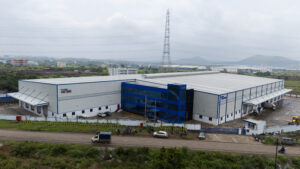
Asahi India Glass Ltd.

REFERENCE LINKS
Performance Testing and Comparison of Turbine Ventilators
General FAQs
Neither is universally more effective — a Ridge Monitor generally performs better for continuous, large-scale ventilation in big PEBs, while a Turbo Ventilator is often more practical for targeted, point-based ventilation in existing sheds. The right choice depends on building size, wind conditions, and whether it's new construction or a retrofit.
Ridge vents suit large PEBs needing continuous ventilation, while turbo ventilators work better for targeted, point-based ventilation in existing sheds — the right choice depends on building size and wind conditions.
Yes, combining both can improve coverage, but only when based on proper airflow analysis — otherwise the systems can work against each other.
The most common issues are reduced performance in low-wind conditions, bearing wear over time, and corrosion at mounting points if not inspected regularly
For most large PEBs, yes — but it should be paired with adequate fresh-air inlets (wall louvers, doors) to work effectively, since exhaust-only systems underperform without matched air intake
Not when properly designed and installed — quality ridge monitors include weather protection like louvered or baffled openings, plus correctly detailed flashing.
A ridge vent (or ridge monitor) is a raised opening along a building's roof ridge that lets hot air escape continuously using the stack effect.
With proper installation and routine maintenance, ridge monitors typically last several decades since they have no moving parts to wear out.
Need Help?
Download Our Company Profile
Please fill in the form below to receive the brochure.
This will close in 0 seconds
Email us with any questions or inquiries.