
Pre-Engineered Buildings (PEB) are widely used for warehouses, factories, manufacturing plants, logistics facilities, and other industrial buildings. However, the PEB erection stage requires careful planning because structural members are lifted, positioned, aligned, bolted, and braced on site.
During PEB erection work, columns, rafters, purlins, girts, roof sheets, and wall panels are installed in a planned sequence. Until the required bracing and connections are completed, the partially erected frame can be vulnerable to wind, lifting errors, and instability. This makes proper PEB erection safety essential for protecting workers and maintaining structural stability.
This guide explains practical PEB erection safety practices covering site preparation, structural steel erection, crane and lifting operations, work at height, panel installation, weather conditions, daily inspections, and site safety management.
PEB erection is the process of assembling and installing the pre-engineered steel building components at the project site. The PEB erection process typically includes positioning columns, lifting and connecting rafters, installing purlins and girts, providing temporary and permanent bracing, and completing roof and wall panel installation.
Strong Steel Structure Erection Safety practices give contractors real, measurable benefits:
In real life, safety and speed go together on a PEB site. Teams that erect steel in a careful, well-planned order also finish faster, because they are not stopping again and again to fix problems that could have been avoided.
A skilled erection contractor always starts with a written safety plan made just for that project — not an old template copied from the last job. Every PEB frame is different in bay spacing, roof height, and bracing layout, so the lifting order and safety steps need to be worked out for that exact structure, not guessed from past experience alone.
A good plan should cover:
For example, on a 60-metre wide warehouse, the usual practice is to fully fix and brace the first two end bays before the crane moves on to the next one. These first bays hold the whole structure steady while the rest is built. Skipping this step to save a day of crane time is one of the most common reasons a frame leans or shifts out of shape on site.
Clear planning is the base of good PEB Installation Safety Measures. It turns erection from a series of separate lifts into one planned, controlled process.
Checking the site is not just a formality — it is the last chance to catch a problem with the foundation or access before it turns into a real crisis in the middle of erection. If an anchor bolt is out of place and this is found only after a column is already lifted into the air, fixing it costs far more time and is far more dangerous than catching it during a walk-through before work begins.
A good inspection should check:
A useful field habit is to walk the anchor bolt layout on the ground with a printed grid drawing before the crane arrives. A gap that looks fine on a survey report can look very different once it is checked bolt by bolt against the actual base plate.
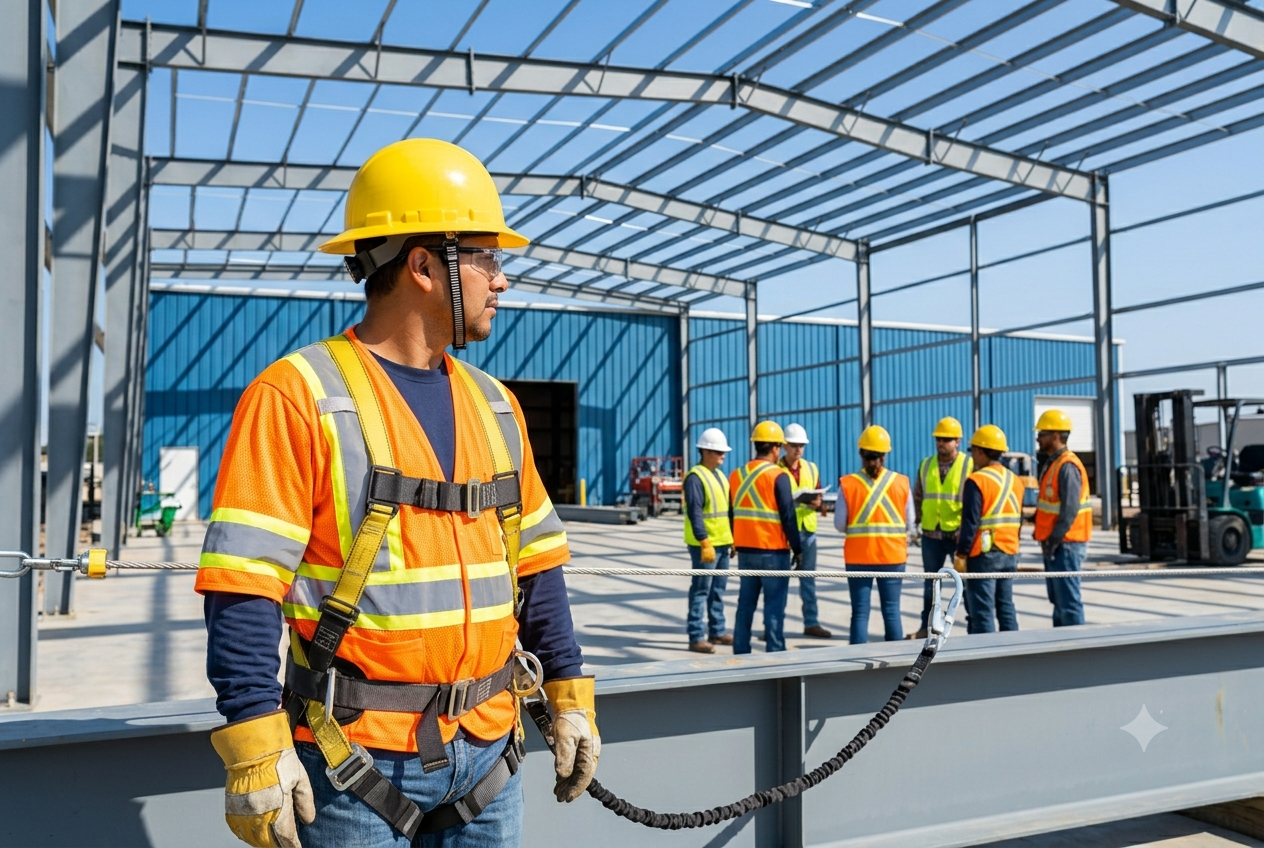
PPE is the last layer of protection, not the first, but it is still a must on every PEB site. It is not enough to just say “wear PPE.” The right gear must be matched to the actual task, and it must be checked to be in good, working condition before every shift.
Basic gear needed for PEB erection crews includes:
Training matters just as much as handing out the gear. A harness that is worn but not clipped to the right point, or a lanyard clipped to a weak purlin instead of a proper anchor point, gives a false sense of safety that can be worse than wearing no harness at all. Checking harnesses and lanyards before use should happen every single day, not just now and then.
Safe PEB erection procedures help keep the partially assembled structure stable throughout the erection process. Each steel member should be installed according to the approved drawings and planned erection sequence. The work should progress only after the required connections, alignment, and temporary bracing have been checked.
The main stages of PEB erection work generally include:
A partially erected PEB frame can behave differently from the completed building, particularly during strong winds. Temporary bracing and guy wires should remain in place until the frame has sufficient stability and the responsible engineer or supervisor confirms that it is safe to proceed.
Panel erection is an important stage of PEB installation because roof and wall panels are often handled at height and can be difficult to control in windy conditions. Panels should be lifted, positioned, aligned, and fixed using suitable equipment and safe work practices.
During PEB panel erection, workers should:
Proper planning during panel erection reduces the risk of falls, damaged panels, unstable materials, and delays during installation.
Heavy lifting is the single riskiest task on a PEB site, and it is where most serious accidents start. Cranes, hoists, slings, and shackles must match the real weight, size, and balance point of the part being lifted — not just be judged “strong enough” by eye.
Before every major lift, the team should check:
Crane and lifting operations should also follow applicable requirements for equipment inspection, ground conditions, rigging, signaling and operator safety, including OSHA 29 CFR 1926 Subpart CC – Cranes and Derricks in Construction.
Falling from height is still the top cause of death in steel construction around the world. Workers who fit roof sheets, purlins, and other high parts must follow fall-protection steps every time — even for short, “quick” jobs, since that is often when people get careless and accidents happen.
Work-at-height controls should be planned around the actual fall hazards present on the site and applicable requirements such as OSHA 29 CFR 1926.501 – Duty to Have Fall Protection.
A written PEB Site Safety Checklist turns safety from a guess into a daily record anyone can check. The real value is not the checklist itself, but what each item actually confirms. The table below explains why each key check matters, instead of just listing them with no context.
| Checklist Item | Frequency | Why It Matters |
|---|---|---|
| PPE worn and in good condition | Start of shift | Worn-out PPE, like a frayed harness or a cracked helmet, can fail at the exact moment it is needed most. |
| Crane and lifting equipment checked | Daily, before first lift | Catches worn wire rope, hydraulic leaks, or brake problems before a load is in the air. |
| Slings, hooks, and shackles rated for the load | Before each major lift | Wrong or damaged rigging is a top cause of loads being dropped. |
| Temporary bracing fitted and secure | After each bay erected | The frame is weakest during erection; missing bracing is a direct threat to its stability. |
| Work areas clear of debris and obstructions | Continuous | Cuts down trip hazards and keeps emergency exit paths open. |
| Weather suitable for erection work | Before and during lifting or work at height | Wind and lightning are the two most common reasons to pause erection work. |
| Restricted zones kept clear around lifting work | Continuous during lifts | Stops workers from being hit by a load, the crane, or a falling part. |
| Panel erection equipment and work area checked | Before panel installation | Helps prevent unsafe lifting, damaged panels, and hazards during installation |
A named supervisor should sign off the checklist every shift, and it should be kept as part of the project’s safety records — both for internal review and for audits by the government or the client.
PEB erection usually brings together supervisors, crane operators, riggers, steel erectors, safety officers, and several subcontractors, all working close to one another. A mix-up in communication during a lift is not a small problem — it is one of the fastest ways a normal task turns into an accident.
Workers should always know clearly who has the authority to give lifting orders at any moment. On sites with several subcontractors, two supervisors giving different orders during the same lift is a common and fully avoidable cause of near-misses.
Weather has a big effect on Safe Practices for Industrial Steel Buildings during erection, because long, light steel parts and roof sheets catch a lot of wind. A gust that would mean nothing to a finished, closed building can make an unsupported rafter or roof sheet very hard to control.
Work should be checked again or stopped during:
The site supervisor should check both the weather forecast and the real conditions on site before allowing critical lifts or work at height. A forecast is only a guide — conditions on an open industrial site can change faster than the forecast predicts.
PEB Contractor Safety Compliance keeps safety standards steady when several contractors and subcontractors work on the same site under different managers. One weak link — a single subcontractor with poor standards — can pull down the safety culture of the whole project.
A truly proactive safety culture is not measured only by how few accidents happen — it is measured by how many near-misses get reported. A site where workers feel safe reporting a close call is a site where hazards get fixed before anyone gets hurt.
Good housekeeping is easy to skip on a fast-moving erection schedule, but scattered materials, loose tools, packaging, and unused parts keep causing trip, fall, and fire hazards — especially around crane and lifting zones, where the ground needs to stay clear.
Beyond safety, well-organised material staging also speeds up erection. Crews spend less time hunting for the next part when materials are placed in order, exactly where the erection plan expects them to be.
Safety training loses its value fast if it is only given once, at the start, and never again. Regular toolbox talks keep the crew aware of the specific dangers of that day’s work, not just general rules they memorised on day one.
The best toolbox talks are short, focused on that day’s actual tasks, and given right at the work spot instead of in a general briefing room. A five-minute talk next to the crane about that morning’s lift plan is remembered far better than a long classroom session.
More PEB sites are now using technology to support safety work, not to replace it. Wearable sensors can show, in real time, if a worker’s harness comes unclipped or if there is an unusual fall event. Drones can check roof-line bracing and sheet alignment without sending an inspector up to height. Digital checklists and site apps make daily inspection records easier to fill in, time-stamp, and check later than paper logs. Some sites now also use cameras with smart software to warn when a worker steps into a crane’s restricted zone.
These tools do reduce risk, but they cannot replace an experienced person’s judgement on site. A sensor can show that a harness was unclipped, but it cannot tell if that was needed to move around an obstacle and reconnect safely, or if it was simply a shortcut. A drone photo can show that a brace looks fitted, but only a qualified engineer can confirm the bolt is tightened to the correct level. A wind sensor can record a gust, but only an experienced supervisor, thinking about the load, the rigging, and how tired the crew is at that moment, can decide if the lift should go ahead.
The simple lesson for PEB projects is this: treat technology as one more source of information for the supervisor and safety officer, not a replacement for their trained judgement, and not a reason to cut down the number of experienced people actually on site.
A small number of repeated mistakes cause a large share of erection accidents:
Avoiding these mistakes clearly improves both worker safety and how fast the job gets done, since accidents — even small ones — usually cost far more time than the shortcuts that caused them ever saved.
Safety is not just the safety officer’s job. Good PEB Erection Safety Practices need steady effort from project managers, design engineers, site supervisors, contractors, and every worker on the crew.
When safety becomes part of the daily routine of erection, instead of a separate box to tick, PEB projects tend to move faster overall, because fewer days are lost to accidents, rework, or work stoppages.
PEB construction offers real benefits in speed, cost, and flexibility, but these benefits only hold up if the erection stage is done safely. From checking the foundation and running the crane, to fall protection and keeping the structure stable, every step depends on sticking closely to the set procedures.
Safe PEB erection depends on proper planning, stable erection sequences, suitable lifting equipment, effective fall protection, and regular site inspections. From foundation checks and steel member installation to bracing, panel erection, and final inspection, every stage should follow an approved and controlled procedure. (change)
Following these PEB erection safety practices helps protect workers, maintain structural stability, reduce installation errors, and keep industrial construction projects on schedule. A well-planned erection process supports both safety and the long-term performance of the completed building.
Our Projects
Hyundai Glovis India
JSW Steel Ltd.
John Deere
SANY Heavy Industries
Hyundai Mobis
Asahi India Glass Ltd.
General FAQs
Falls from height and crane or lifting accidents together cause most of the serious injuries in steel erection. Both risks are highest while the frame is only partly braced, which is why temporary bracing and fall protection are treated as the two top priorities.
Common standards include OSHA 1926 Subpart R (Steel Erection) in the US, IS 800:2007 for steel design and construction in India, and ISO 45001, which covers safety management systems in general. Projects should check which national or local rules apply based on location and client requirements.
Safety is a shared job: the main contractor is usually responsible for overall site safety, the erection subcontractor is responsible for their crew following the rules, and every worker is responsible for following procedures and reporting hazards. A dedicated safety officer coordinates and checks compliance across everyone.
Daily checks are normal for PPE, access routes, and general housekeeping. Crane and lifting equipment should be checked before each shift, and key items like temporary bracing should be checked after every bay is erected, not only at the end of the day.
At minimum: a rated safety helmet, safety shoes with toe protection, a full-body harness with two lanyards for work at height, cut-resistant gloves, impact-rated eyewear, and high-visibility clothing. Certain tasks may need extra gear, such as ear protection or welding-specific PPE.
Not for lifting or height work once wind speed goes above the crane maker's rated limit, or the lift plan's specific limit for that load, whichever is lower. Large, light parts like long rafters or roof sheets can become unsafe to handle well before the crane itself reaches its general limit.
The main steps include site and foundation checks, column erection, rafter installation, temporary and permanent bracing, purlin and girt installation, roof and wall panel erection, alignment, connection checks, and final inspection.
Need Help?
Download Our Company Profile
Please fill in the form below to receive the brochure.
This will close in 0 seconds
Email us with any questions or inquiries.